
If you have heard a merchant-services rep pitch "eliminate your processing fees," they were almost certainly talking about one of three programs: surcharge, cash discount, or dual pricing. The marketing makes them sound interchangeable. They are not, and the difference matters - for compliance, for customer experience, and for which one actually works in your business.
Surcharge
A surcharge is an explicit fee added to the transaction when a customer pays by credit card. If the shelf price is $100 and the surcharge is 3%, the credit card customer pays $103. Cash and debit customers still pay $100.
Surcharges are legal in most US states, but they come with rules from Visa and Mastercard: you must register the program with the card brands before you start (typically a 30-day notice), the surcharge can never exceed your actual cost of acceptance, you must disclose the surcharge at the point of sale and on the receipt, and it only applies to credit cards - not debit, even when the debit card is run as credit.
A handful of states have surcharge restrictions or outright bans, and the list has shifted over the past few years. We always check the current rules for a client's state before enrolling them in any surcharge program.
Cash discount
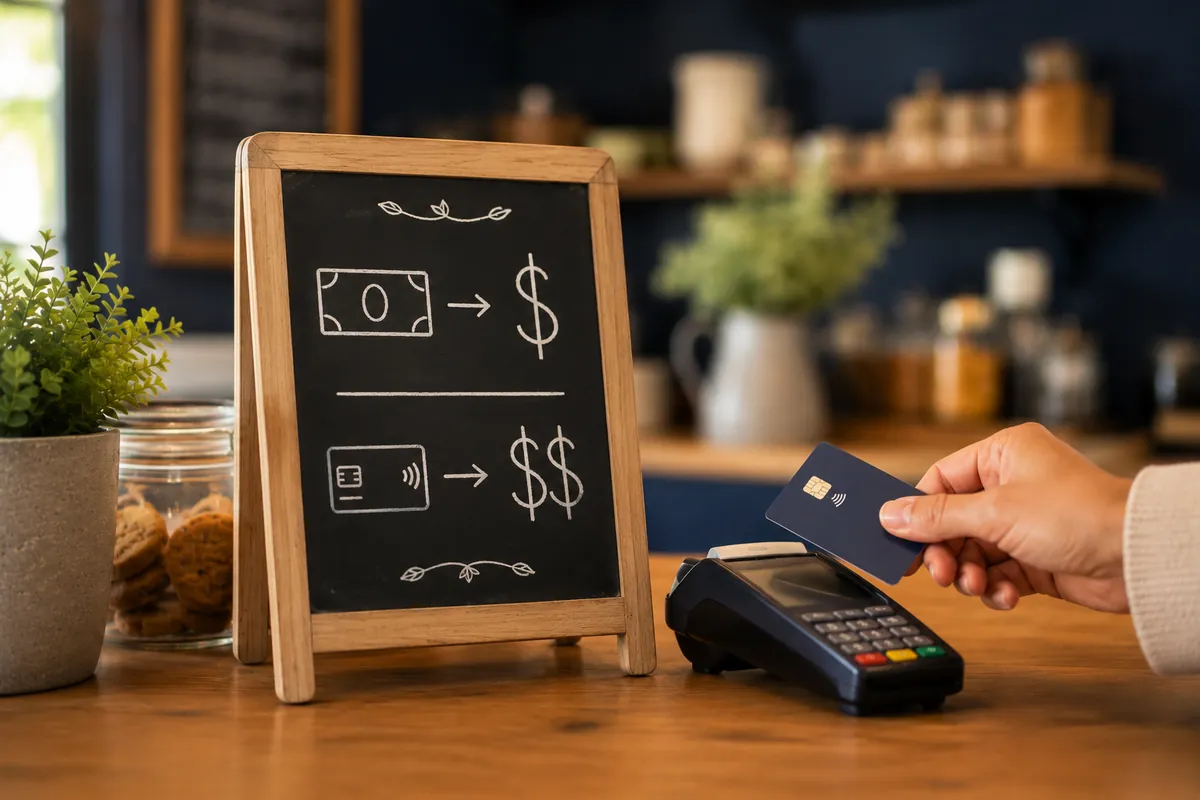
A cash discount inverts the framing. The shelf price already includes the processing cost; if you pay cash, you get a discount. Same dollars to the merchant either way - the customer just sees "$100 if you pay cash" or "$103 if you pay by card."
Cash discounts are easier from a compliance standpoint because they are not subject to most state surcharge bans (you are reducing the price for cash, not adding a fee for cards). But the disclosure rules still apply and the program has to be set up correctly. Done sloppily, a "cash discount" program can be ruled by regulators to actually be a surcharge in disguise.
Dual pricing
Dual pricing displays both prices openly at the register, on the menu, or on the shelf - one price for cash and a different price for cards. The customer chooses. There is no "fee" added at checkout because the card price is the posted price.
This is the cleanest model from a compliance perspective. It avoids most state-level surcharge issues and most card-brand registration requirements, because nothing is being added at the point of sale - both prices are simply posted.
It is also the model behind our Advo100 program. The point of sale shows both prices, the customer picks, and processing fees effectively move from the merchant to the card-paying customer who is using the more expensive payment method anyway.
Which one fits which business
- Retail with a register/POS: dual pricing usually wins - the prices can be displayed clearly and customers self-select.
- Restaurants: dual pricing works well on the menu; cash discount can also work if you mark prices accordingly.
- Service businesses with invoices: cash discount fits naturally - the invoice can show the discounted price for ACH or check.
- Liquor stores and convenience stores: dual pricing is common and well-accepted in these categories. We have a lot of experience here.
- eCommerce: harder. Most online checkout flows do not cleanly support dual pricing. Surcharge is possible but the registration and disclosure requirements make it operationally fussy.
- B2B with card-on-file: surcharge or cash discount can work, but check your customer contracts - many B2B agreements prohibit surcharges to corporate cards.
The honest trade-off
Every one of these models works in the right business. The savings are real - for a typical retail merchant doing $25-$35K in monthly card volume, dual pricing or a well-run cash discount program can effectively eliminate processing fees from the merchant's bottom line.
The trade-off is customer perception. Some customers love it. Some grumble. A rare few walk away. The merchants we see succeed with these programs are the ones who communicate clearly - signage, menu prices, a friendly explanation at the register - and who picked the right model for their business and their state.
If you are weighing one of these programs, send us a statement and tell us what you sell. We will tell you which model fits, what the rules are in your state, and what the actual numbers look like.